

The newly established Excellence Cluster ImmunoPreCept invites outstanding early career researchers from around the world to apply for PhD and Postdoctoral positions in Berlin. We offer PhD positions (E13, 65%) – 3 years contract – and Postdoc positions (E13, 100%) – 2 years contract.
ImmunoPreCept brings together leading experts in medicine, experimental life sciences, and computational approaches to advance the future of precision prevention in immune-mediated diseases. Our interdisciplinary setting fosters collaboration across clinical research, laboratory-based discovery, and cutting-edge data science, creating a unique environment for translational innovation.
Berlin offers not only a thriving research ecosystem but also an inspiring international community and high quality of life—making it an ideal place to launch the next stage of your scientific career.
You can find detailed descriptions of available PhD and Postdoc projects below. Please apply through the Charité application portal.
Apply hereDieter Beule, Core Unit Bioinformatics (CUBI), Berlin Institute of Health at Charité – Universitätsmedizin Berlin & Nils Blüthgen, Institute of Pathology (Campus Charité Mitte), Charité – Universitätsmedizin Berlin
The project aims to uncover early molecular and cellular deviations from immune homeostasis that precede overt disease. By integrating population-scale genomics, single-cell and spatial profiling, and computational approaches, the consortium seeks to identify regulatory principles of immune dysfunction and translate these insights into strategies for early disease interception and precision immunology. The overarching goal is to establish a data-driven framework for understanding how early immune perturbations emerge and how they can be detected and targeted before clinical manifestation. This program is specifically tailored for researchers with a computational background, such as bioinformaticians, computer scientists, mathematicians, and physicists, as well as biologists with strong computational expertise.
This subproject investigates molecular and cellular mechanisms of early immune dysregulation with a particular focus on host–pathogen interactions and immune surveillance. By combining large-scale reanalysis of population sequencing data with targeted single-cell and spatial profiling of immune cells in blood and tissue, the project aims to identify host pathways that regulate viral persistence, immune activation, and early deviations from immune homeostasis. Mechanistic follow-up studies will interrogate how innate immune cell populations and antigen presentation pathways contribute to the control or failure of immune regulation. The overarching objective is to establish early, system-level biomarkers of immune dysfunction that may inform immune monitoring and early intervention strategies. The project particularly engages researchers with computational expertise, leveraging their skills to analyze complex datasets and model immune regulatory networks.
This subproject focuses on systems-level and computational approaches to dissect the regulatory architecture of immune homeostasis and its breakdown in disease. By integrating multi-omics datasets across cohorts and experimental systems, the project aims to construct network-based and predictive models of immune regulation. Machine learning and quantitative modeling will be used to identify key regulatory nodes, dynamic control principles, and emergent properties of immune networks that precede overt pathology. The long-term objective is to develop mechanistically grounded, data-driven models that enable prediction of early immune perturbations and support rational target identification for precision immunology. This subproject is designed for researchers with a computational background or for biologists with strong computational training who can contribute to modeling and data integration efforts.
Prof. Dr. Simon Haas, Berlin Institute of Health at Charité – Universitätsmedizin Berlin & Prof. Dr. Ulrich Keller, Department of Hematology and Oncology (Campus Benjamin Franklin), Charité – Universitätsmedizin Berlin (in collaboration with Prof. Dr. Gerhard Krönke, Department of Rheumatology and Clinical Immunology (Campus Charité Mitte), Charité – Universitätsmedizin Berlin German Rheumatology Research Center)
Immunotherapies have transformed the treatment landscape of multiple hematological cancers and are now emerging as highly promising therapeutic strategies for autoimmune diseases. Despite these advances, it remains poorly understood why some patients achieve durable responses while others relapse early, and why certain individuals develop severe immune-related adverse events whereas others tolerate treatment without complications. Addressing these unresolved questions is essential to improving both the efficacy and safety of immune-modulating therapies.
This project leverages cutting-edge single-cell and spatial multi-omics technologies to dissect the cellular and molecular mechanisms underlying therapeutic response and resistance. Using an innovative cross-disease framework, we will directly compare patients with hematological cancers and patients with autoimmune diseases who receive mechanistically related immunotherapies. This cross-disease approach enables the identification of shared and context-specific principles by which immunotherapies eliminate malignant or autoreactive immune cells, as well as the mechanisms through which pathogenic clones persist, adapt, or re-emerge during disease recurrence.
A particular focus will be placed on the bone marrow, a central immune organ that serves as the origin of leukemias, a reservoir of long-lived plasma cells, and a niche for autoreactive B and T cell populations. As a site of hematopoiesis, immune memory maintenance, and clonal selection, the bone marrow represents a critical yet poorly understood compartment in mediating systemic responses to immunotherapy. By integrating longitudinal sampling with high-resolution profiling of immune cell composition, clonal dynamics, antigen receptor repertoires, and spatial interaction networks, we aim to define the immune ecosystem states associated with durable remission, relapse, and treatment-associated toxicity.
Ultimately, this project seeks to establish a mechanistic and predictive framework for understanding how immunotherapies reshape immune memory and clonal architecture across diseases. By identifying conserved immune states, escape pathways, and biomarkers of response, we aim to develop strategies that promote deeper and more durable remissions while minimizing immune-mediated side effects. This cross-disease perspective has the potential to redefine how immunotherapies are optimized, not within isolated disease categories, but across the broader spectrum of immune-driven disorders.
Dr. Efstathios Stamatiades, Institute of Microbiology, Infectious Diseases and Immunology (Campus Benjamin Franklin), Charité – Universitätsmedizin Berlin (in collaboration with Prof. Dr. Frank Tacke, Department of Hepatology and Gastroenterology (Campus Virchow Klinikum), Charité – Universitätsmedizin Berlin)
This project investigates how metabolic disease imprints long-lasting changes on tissue-resident immune cells and how far these changes can be reversed upon disease regression. Focusing on metabolic dysfunction–associated steatotic liver disease (MASLD) as a clinically relevant model of reversible chronic inflammation, the project aims to define whether immune homeostasis is fully restored after weight loss or pharmacological intervention, or whether a persistent inflammatory “memory” remains. By integrating human samples with mechanistic studies in mouse models, the overarching goal is to understand immune reprogramming during disease regression and to identify principles that determine durable remission versus vulnerability to relapse.
This project investigates how hepatic macrophages and innate lymphoid cells are functionally and epigenetically reprogrammed during MASLD progression, regression, and relapse. Using complementary mouse models of obesity- and inflammation-driven MASLD together with human liver and extrahepatic tissue samples, it will define how Kupffer cells and monocyte-derived macrophages contribute to immune recovery, tissue repair, and the persistence of inflammatory “memory” after metabolic injury. High-dimensional single-cell and spatial profiling, multiplex tissue imaging, intravital microscopy, and lineage-specific perturbations will be employed to map cellular and molecular changes across liver, kidney, bone marrow, and adipose tissue. These studies aim to uncover multi-organ immune imprinting and identify mechanisms that can be targeted to promote durable remission and prevent relapse.
Prof. Dr. Antigoni Triantafyllopoulou, Department of Rheumatology and Clinical Immunology (Campus Charité Mitte), Charité – Universitätsmedizin Berlin & German Rheumatology Research Center (in collaboration with Prof. Dr. Volker Siffrin, Department of Neurology with Experimental Neurology (Campus Charité Mitte), Universitätsmedizin Berlin & Experimental and Clinical Research Center)
This project aims to understand how persistent viral infections shape immune regulation and contribute to chronic disease. By integrating clinical cohorts with mechanistic studies, the project investigates how early perturbations in immune–tissue communication can shift immune homeostasis toward pathology. The overarching goal is to identify molecular and cellular mechanisms that transform normally tolerated immune responses into tissue-specific autoimmunity, providing a foundation for therapeutic interception and durable disease control.
This project examines how Epstein–Barr virus (EBV) reprograms B cells in the context of HLA-restricted immune recognition, driving autoimmune responses in multiple sclerosis (MS) and systemic lupus erythematosus (SLE). Using HLA-matched patient cohorts and mechanistic mouse models, the project will trace EBV-positive B-cell clones and link their clonal dynamics to transcriptional, epigenetic, and functional phenotypes. Immunopeptidomics, T-cell assays, and single-cell profiling will identify self-antigens presented by EBV-infected B cells, distinguish pathogenic from non-pathogenic responses, and reveal regulatory circuits that maintain tolerance, clarifying why EBV – but no other persistent viruses – triggers autoimmunity in susceptible individuals.
Prof. Dr. Nikolaus Rajewsky, Berlin Institute for Medical Systems Biology of the Max Delbrück Center (in collaboration with Prof. Dr. Ashley Sanders, Berlin Institute for Medical Systems Biology of the Max Delbrück Center)
This project investigates how rare, therapy-resistant tumor clones persist in specialized microenvironments and drive long-term recurrence. By integrating spatial, single-cell, and long-read genomic technologies, the project aims to uncover how microenvironmental niches and clonal dynamics interact to maintain residual disease. The ultimate goal is to identify mechanisms of dormancy and relapse that can inform biomarker-guided therapeutic strategies.
This project focuses on invasive lobular carcinoma, a breast cancer subtype defined by diffuse growth, estrogen receptor positivity, and dense, fibroblast-rich stroma. Using patient-derived biopsies and organoids, spatial transcriptomics will map tumor-stroma interactions, Strand-seq will resolve clonal relationships, and Oxford Nanopore long-read sequencing will detect structural variants and methylation patterns. Together, these approaches will reconstruct the spatial-clonal landscape of ILC, identify persistent therapy-resistant clones, and reveal microenvironmental factors that enable long-term tumor dormancy and recurrence.
Prof. Dr. Ashley Sanders, Berlin Institute for Medical Systems Biology of the Max Delbrück Center (in collaboration with Prof. Dr. Britta Siegmund & Prof. Dr. Carl Weidinger, Department of Gastroenterology, Infectious Diseases and Rheumatology (Campus Benjamin Franklin), Charité – Universitätsmedizin Berlin)
This project investigates how therapeutic and inflammatory exposures shape the genome of tissue-resident cells and influence disease outcomes. Using human organoids and patient samples, it aims to identify molecular mechanisms that distinguish adaptive, protective remodeling from pathological genomic failure. Insights will provide predictive markers for therapy response and guide strategies to maintain tissue homeostasis in chronic disease.
This project focuses on how inflammatory bowel disease (IBD) therapies and cytokines affect DNA integrity in the intestinal epithelium. Using patient-derived colonic organoids and paired biopsies, the project will map therapy- and cytokine-induced mutational signatures with Strand-seq and deep whole-exome sequencing, integrating DNA damage, structural variants, and subclonal evolution. Longitudinal patient samples will allow correlation of mutation patterns with treatment outcome, distinguishing adaptive (protective) versus maladaptive (pathogenic) genomic remodeling. Together, these studies aim to uncover mechanisms by which therapy and inflammation remodel epithelial genomes and identify predictors of sustained remission or persistent disease.
Prof. Dr. Johannes Vogel, Museum für Naturkunde & Charité – Universitätsmedizin Berlin (in collaboration with Dr. Mhairi Stewart, Museum für Naturkunde; Dr. Benedikt Fechner, Wissenschaft im Dialog; Prof. Dr. Stefanie Molthagen-Schnöring, Hochschule für Technik und Wirtschaft Berlin)
The Berlin Hub for Science and Society (BHSS) is part of the ImmunoPreCept Excellence Cluster and serves as a “Think and Do Tank” to strengthen connections between science and society. BHSS combines cutting-edge public engagement practice with rigorous research to explore how science communication and engagement impact both academic and non-academic communities. The hub fosters interdisciplinary exchange, evidence-based reflection, and development of frameworks that support socially embedded, responsible, and high-quality science.
This subproject focuses on developing an empirically grounded model of science communication and public engagement (SCaPE). Using qualitative and quantitative methods – including surveys, interviews, focus groups, and mixed-methods analysis – the project will map motivations, outcomes, and impacts of public engagement for researchers and practitioners. Key objectives include designing and testing the SCaPE model, creating a standardized evaluation framework for research impact within ImmunoPreCept, and translating findings into peer-reviewed publications, internal reports, and practitioner guidance. The project also involves mentoring BHSS PhD students and collaborating with interdisciplinary teams to embed evidence-based public engagement and impact assessment into institutional structures.
Prof. Dr. Ashley Sanders, Berlin Institute for Medical Systems Biology of the Max Delbrück Center (in collaboration with Prof. Dr. Michael Sigal, Department of Hepatology and Gastroenterology (Campus Virchow Klinikum), Charité – Universitätsmedizin Berlin)
This project aims to understand how environmental exposures and genetic predispositions interact to drive the transition from tissue health to disease. By integrating clinical cohorts with advanced single-cell, genomic, and organoid approaches, the project seeks to identify early molecular events that mark the tipping point toward malignancy. Insights will provide mechanistic understanding and potential predictive markers for early detection and intervention.
This subproject focuses on the early stages of gastric cancer, particularly in BRCA1/2 mutation carriers who are also exposed to Helicobacter pylori. Using prospectively recruited patients, paired biopsies, and patient-derived organoids, the project will apply single-cell RNA-seq, Strand-seq, and integrative genomic analyses to define the molecular bifurcation point from premalignant lesions to irreversible malignant transformation. It will map mutation burden, clonal dynamics, and transcriptional programs to distinguish reversible adaptive responses from irreversible carcinogenic changes. Mechanistic studies in organoids will dissect the role of bacterial virulence factors and DNA-repair deficiencies, providing causal insight into early gastric tumorigenesis and identifying potential targets for intervention.
Dr. Aydan Bulut-Karslioglu, Max Planck Institute for Molecular Genetics & Dr. Vikram Sunkara, Zuse Institute Berlin & German Rheumatology Research Center
Tissue-resident immune cells are central to maintaining homeostasis and preventing autoimmune disease, yet the mechanisms that sustain this equilibrium remain poorly understood. Failure to maintain a low-divergence homeostatic state in response to nucleic acids and other stimuli can trigger autoimmune conditions such as systemic lupus erythematosus (SLE). This project aims to define the transcriptional and epigenetic states that characterize low-divergence, homeostatic immune populations, and to map the immune-tissue networks that maintain this balance. Insights will inform strategies to restore homeostasis and prevent disease onset.
Leveraging single-cell transcriptomics and epigenomics from mouse models and human SLE cohorts, the project will identify low-divergence immune cell populations and characterize their regulatory states. Advanced AI and deep learning approaches – including explainable AI (XAI) and vector field analysis – will define divergence thresholds and predict how tissue-resident immune cells respond to external nucleic acids. For the XAI aspect of the project, we are seeking a postdoc with prior experience in Differential Geometry and Scientific Computing. Spatial transcriptomics, 3D imaging, and multiplex immunofluorescence will map the interactome of tissue-resident innate cells, revealing key signaling pathways that sustain homeostasis. Peripheral blood analyses will validate functional and epigenetic signatures in humans, linking mechanistic insights from tissue to clinically accessible biomarkers. This integrated framework aims to uncover actionable networks that maintain tissue homeostasis and prevent autoimmune activation.
Prof. Dr. Ana Pombo, Berlin Institute for Medical Systems Biology of the Max Delbrück Center, Dr. Felix Weiss, German Rheumatology Research Center)
Using high-resolution nuclear mapping techniques, this project aims to understand how allele-specific intra-nuclear localization and epigenetic modifications affect allele choice during inflammation, and how this impacts effective host defense responses and the development of auto-inflammatory diseases.

Work within interdisciplinary teams across multiple institutes.
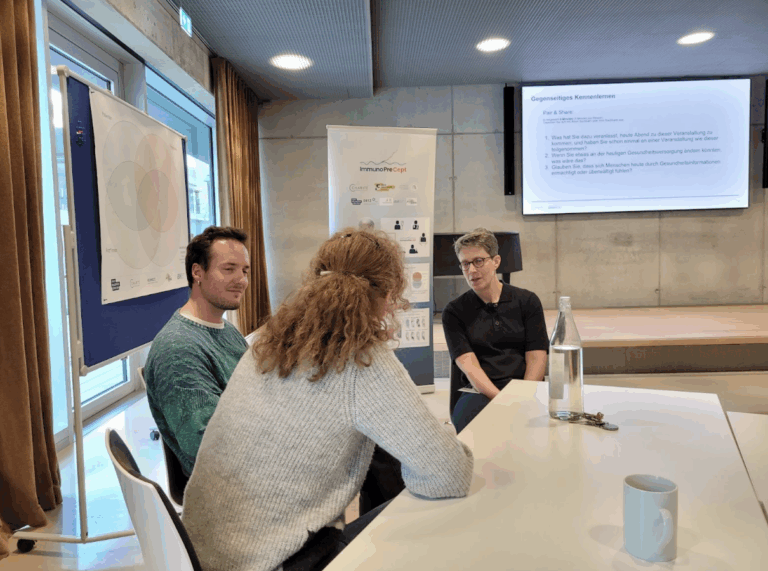
Explore opportunities for interactions with ImmunoPreCept research and researchers.